











Green Miles - Industry Insight
Are we at the “tipping point” for logistics decarbonisation?
By Stephanie Haszczyn, Logistics UK Senior Policy Manager.
According to the UK’s Climate Change Committee (CCC), climate change is making extreme weather in the UK more likely and even more severe.
More than a third of railway and road kilometres are currently at flood risk, which impacts road safety and accessibility, and this is predicted to rise to a staggering 50% of roads by 2050. The impact on the UK economy is projected to be significant, at 7% of GDP by 2050. It is for these reasons amongst others that the UK chose to legislate to be net zero by 2050 and do its part to reduce its emissions and reduce its impact on wider climate change consequences.
To be a net zero economy, the UK government will require emissions reductions from across all industries and sectors. For transport, which is currently the highest emitting sector, reductions are projected to be significant. At Logistics UK’s Delivering Decarbonisation event which took place on 27 November, decarbonisation pathways for logistics was at the forefront of the discussion.
For Guy Opperman, former Minister for Roads and Local Transport at the Department for Transport (DfT), logistics is well on its way to achieving decarbonisation success stories which are deliverable across all use cases. Opperman’s optimism reflected his view that logistics has met its “tipping point” and so from hereon, the hardest part of logistics decarbonisation is already behind us.
So how can he be so optimistic?
From now to net zero

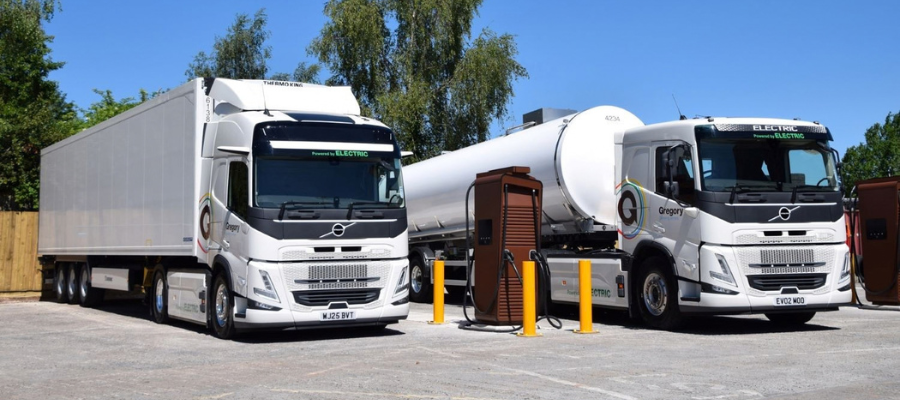
Our conference came the day after the launch of a new Logistics UK report – Powering Change: building a credible plan for decarbonising road logistics which reflects a diversity of views from the industry. In our report, we reflect on how operators are trialling multiple solutions, from electric HGVs to procuring UK-sourced biofuels, and from hydrogen powered cars to solar farms being installed on their warehouses.
And this is what we’re hearing directly from industry. In Powering Change, our survey results reflected on the pathways that they forecast to be the way forward, and how all fuels are seen to play a role to decarbonise operations. Diesel use is projected to decline significantly, with its share dropping from 80.5% in 2025 to 50.9% by 2030. We know this is already having an impact on government, with the recent Budget announcement looking for alternative ways to make up the lost fuel-duty revenue as more vehicles transition away from fossil fuels.

Big industry is also sharing its willingness to collaborate and support other businesses, particularly SMEs to decarbonise too. We’ve seen initiatives which support supplier use of low-carbon fuels, as well as initiatives which encourage the use of shared depot charging infrastructure – a positive effort to ensure that businesses which do not have charging infrastructure at their depots do not only rely on the use of public charging infrastructure, which is generally much more expensive.
Logistics operators have also shared how they are looking to open up their depots to SMEs to encourage them to electrify their fleets by ensuring they have access to more affordable charging infrastructure. With Scope 3 emissions reporting on the horizon, many larger companies see their support of the transition as imperative to achieving their own emissions targets.

Given the significant role SMEs play in road freight, supporting them to decarbonise is essential if the UK is to meet its net zero commitments. If SMEs are not supported to decarbonise, then logistics will not succeed in bringing down its emissions sufficiently. In Powering Change, Logistics UK calls on policymakers to design commercial transport decarbonisation policies that reflect the operational realities faced by most smaller businesses.
What’s slowing progress?
Cost, payload issues, range and infrastructure concerns all come out top in our recent survey data as reasons for a slower transition to electric vehicles (both LCVs and HGVs).
For low-carbon fuel, cost, limited refuelling availability and concerns over the sustainability of these fuels topped the reasons for hesitancy.
In contrast to the optimism of the Delivering Decarbonisation conference, our report survey strongly reflected industry-wide uncertainty on support, guidance and infrastructure. But you can’t manage what you can’t measure – so even receiving this feedback from industry means that policymakers and thought leaders can be called upon to further support industry with these challenges.

What’s ahead?
2026 is already presenting itself as a year full of possibilities and change in the green logistics space. We’re expecting big updates from the ZEHID trials, as all vehicles and infrastructure are scheduled to be operational by March 2026, with on-road demonstration to start by then at the latest.
Progress in technology is exciting, and as we heard from one of the ZEHID consortia during our conference, these programmes are expanding their remit to pursue opportunities such as electric vehicle lightweighting to offset the payload loss from the heavier powertrains. ZEHID partners are also ensuring smaller businesses who may have missed the initial opportunity to be involved are able to trial these electric HGVs. What we hear time and time again is that collaboration is the key to unlocking the transition.
We’re also expecting the first trials of autonomous vehicles in the UK. Although this kind of innovation is already in operational trials in the US and China, it will be a huge turning point for the UK. China is moving much more quickly, with autonomous HGVs in trial on Chinese roads and operations already, and with the price of some Chinese-brand HGVs at a similar price point to their ICE equivalents. These kinds of market disruptors could be positive news for UK operators looking to trial electric vehicles without the higher mark-up, once the vehicles hit the UK market in 2026.
Industry is telling us that this isn’t a discussion of “whether” anymore, just “when” – and many logistics operators are powering change and leading the drive to net zero in their industry.
Member notice:
If you’re a member and you want to share your experience or get involved in our policy work here at Logistics UK, we’re keen to hear from you. Our Decarbonisation Working Group meets three times a year and it’s a forum where we host external speakers, discuss ongoing policy consultations and share use cases and experiences. If you want to hear more and join, email the Working Group Secretary, Steph.
More Green Miles - Industry Insight Articles




Related Pages
Check out more news and media
Discover More

Become a Member
Our membership packages provide you with the tools to keep your operation safe, efficient and compliant.
Learn more

Press Releases
Latest updates, insights, and expert commentary shaping the future of logistics, transport, and supply chains across the UK.
Learn more

Services
Discover the full range of services from Logistics UK, designed to keep your operation safe, efficient, and compliant.
Services

Events
Discover upcoming Logistics UK events designed to bring industry leaders, policymakers, and businesses together.
Events
Stay Ahead. Stay Compliant. Stay Connected.
Join thousands of logistics professionals using Logistics UK to navigate industry change with confidence.
Join Us