













Green Miles - Industry Insight
Reap the wild wind – the case for wingsails
De-risking wind propulsion with guaranteed, scientifically verified fuel savings by Di Gilpin, CEO Smart Green Shipping.
Smart Green Shipping is an award-winning collaborative, systems-design house. It develops technical, commercially viable, digitally enabled wind-powered solutions to accelerate shipping’s green transition.
Di Gilpin leads Smart Green Shipping. She has 30+ years’ experience developing and leading dynamic innovative business system solutions in F1 motor racing, yacht racing, financial information and renewables.
Dianne sits on the UK Department for Transport Clean Maritime Council; is a European Green Shipping Expert for EU Waterbound Transport Platform; a BBC Woman of Power 2020; a recipient of Innovate UK’s ‘Women in Innovation’ Award; and winner of the 2021 International Windship Association’s ‘Outstanding Contribution’ Award.
International shipping is battling significant fuel price and availability uncertainty amidst current geopolitical tensions. This crisis demands new approaches to improve resilience and prevent systemic delivery delays and rising prices for consumers.
The latest turmoil comes against the backdrop of an industry acceleration toward emissions reduction targets, with a growing variety of associated domestic and international regulatory pressures. These multiple, interconnected challenges will be well understood by logistics providers, with every penny of additional cost impacting margins, consumer prices and delivery flexibility amidst increased reporting and compliance demands.
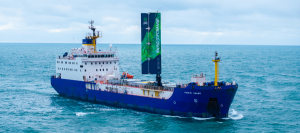
For key segments of the shipping fleet, wind propulsion offers one of the most immediate, proven and cost-effective solutions to these business threats. Existing mitigations like ‘slow steaming’ are a potential fix, but slower ships reduce total fleet capacity.
This means more ships are needed to address demand. Any growth in fleet size increases emissions, and alternative, non-fossil fuels are decades and trillions of dollars away from universal availability, whilst still being exposed to the supply chain vulnerabilities suffered by traditional fuels. This creates uncertainty among shipowners regarding what new future-proof ships to build.
Wind propulsion can counter fuel concerns and boost market capacity
These converging factors are elevating interest in the adoption of wind propulsion technologies, but uptake is hampered by limited trust in performance and fuel-saving claims. Smart Green Shipping (SGS), as the developer of both best-in-class wingsails and scientifically validated wind propulsion prediction tools, can – uniquely – guarantee reduced fuel consumption, operating costs and emissions.
Harnessing the clean, free and abundant renewable energy available to any ship equipped to exploit it significantly improves every aspect of sustainability. Powering ships with wind enabled global trade and, in the 21st century, we’re building aerodynamically optimised autonomous wingsails, that can have a key role in the modern logistics mix. Wind power has already demonstrated its ability to transform domestic energy systems, and now it’s the turn of shipping.
Wind propulsion for shipping as a contemporary solution surfaced in response to the 1970s oil crisis. It faded then because the industry needed more confidence in the performance of what was a nascent technology. This longstanding market barrier – the need for confidence and predictability – has defined our unique strategy.
We now stand at a moment of maximum opportunity for ship owners and operators to realise cumulative benefits from wind propulsion in saving cost, fuel and emissions whilst building commercial resilience in an inevitable high fuel cost future. In a sector with inherent complexity, intensifying geopolitical challenges and a whole range of interconnected market dynamics, it’s understandable that shipowners won’t act without certainty.
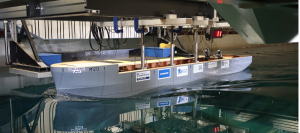
Accelerating adoption of wind propulsion – wind-as-a-service
For this reason, we made the strategic decision to guarantee wind propulsion’s savings using computational tools that simply didn’t exist in the past. We designed a full systems approach – across software (FastRoute, our digital fuel-saving prediction platform) and hardware (the automated FastRig wingsail) – to enable frictionless customer adoption.
We designed FastRig wingsails as a component in a whole system wind-as-a-service solution that enables shipowners to access guaranteed savings with technical and financial certainty to de-risk hardware adoption.
We’ve created this competitive advantage by combining Clyde-built hardware with deep data science. FastRigs are 35 metres tall, autonomous, stowable and designed for quick retrofit onto existing vessels, particularly tankers and bulkers, and general cargo vessels. They were designed with shipowners so installation doesn’t need time in drydock, instead they can be installed port-side, minimising off-hire costs.
We also draw on the circular manufacturing techniques developed for wind turbines, which have been utilised to ensure our wingsails are recyclable and lightweight, with the inherent ability to be reused, repaired and remade.
We built and land-tested FastRigs to demonstrate the robustness of the materials and build approach and to enable crews to experience ease-of-operation before installation on a commercial ship.
Testing has also shown the importance of FastRig’s foldability. Tests on competing hardware found that the ability to fold away is a key differentiator. An inability to stow resulted in a 14% loss of performance in poor winds or headwinds because they cause drag. These margins are vital considerations for ship owners and operators, and they make a meaningful difference to fleet capacity, performance, cost savings, and greenhouse gas emissions. The best way to translate FastRoute’s demonstrated prediction capabilities into the real world was through rigorous and scientifically validated sea trials.
While wingsails are the most eye-catching part of what we do, the crucial element of our integrated wind-as-a-service approach is FastRoute, our proprietary performance prediction software, that predicts fuel savings from FastRig installations across any route at any speed. Developed through years of academic research, with the European Space Agency and the Wolfson Unit for Marine Technology and Industrial Aerodynamics, it combines artificial intelligence with high-performance computing to deliver accurate route and performance predictions, quantifying the value of wind assistance performance to underpin the business case. It is constantly evolving as we build better data sets in line with sector needs.
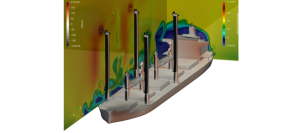
Validating performance prediction software with real-world testing
To be able to guarantee fuel savings and to make finance-grade performance predictions, we worked with academics developing scientifically robust validation protocols. The International Towing Tank Conference (ITTC) wind assistance protocol provides standardised guidelines for predicting, testing, and evaluating the performance of wind-assisted propulsion systems on ships. ITTC guidelines are developed by senior academics from universitiess across the world specialising in ship science, aerodynamics and wind propulsion. They are non-commercial, science-based tools.
To be able to validate FastRoute’s computer generated predictions in the real-world, we chartered a ship for several weeks specifically to research the impact of FastRig’s wind propulsion contribution.
Before embarking on sea trials, the ship was fitted with multiple precision sensors to measure shaft and brake power, sideforce and propeller loading so we could collate the most detailed set of data on whole-ship impacts from wind power.
Using FastRoute we predicted fuel and performance impacts across multiple wind speeds and angles on our chartered ship. Chartering a ship ensured that tests could be run as a first-order priority, with a dedicated team of scientists on board solely focused on accurate, high fidelity data collection. FastRoute model predictions were then evaluated against the reams of real-world data accumulated from 41 sea trial paired runs, that is with the wing being ‘on’ and ‘off’ every 15 minutes to measure the increase in thrust with the wing and without it.
After data screening, 21 runs met the quality criteria required for paired-run analysis. Runs where changes in weather occurred between the ‘on’ and ‘off’ runs were eliminated to ensure most error-free comparisons. Deep data analysis by ship scientists found close agreement between FastRoute predictions and the real-world measured results, confirming exceptional prediction model accuracy, all of which enables us, uniquely, to contractually guarantee fuel savings. Ultimately, the ITTC trial provides a rigorous benchmark to derisk FastRig adoption through our ‘wind-as-a-service’ customer offer.
Dr Joe Banks, Associate Professor in Maritime Engineering at the University of Southampton, found the results compelling, “This project represents one of the most comprehensive wind propulsion datasets gathered from dedicated sea trials and has provided valuable insight into real world performance, allowing improved predictions going forward. The strong overall agreement between predicted and measured performance demonstrates that modern modelling tools can reliably quantify real-world savings, enabling commercial decision-making.”
Real-world implications of test findings
The performance prediction tools, the sea trials and the validated dataset underpin our wind-as-a-service model, which bundles performance forecasting, fuel-saving guarantees, hardware installation, operations and maintenance, compliance support and lease-finance, insurance and standard contractual agreements into a frictionless new business model giving global shipping risk-free adoption of best in class wind propulsion hardware.
With shipping contributing roughly 3% of global emissions and fleet capacity continuing to grow, there is clear space for immediate, scalable, commercially aligned solutions that can tap into free and abundant wind resource to reduce reliance on fuel of any type and provide no-regrets commercial and cost resilience in volatile markets. The only way to be truly successful in this space is to create irresistible business models.
Our approach is enabled by software and backed by the ability to guarantee savings after rigorous real-world testing, including financing and maintenance agreements, which break down longstanding barriers to adopting wind- propulsion. People outside the sector have seen what we’re proposing as an obvious opportunity, but in a complex international transport sector there are multiple interconnected barriers to uptake. Our wind-as-a-service model has been designed to create competitive advantage out of that complexity.
We designed this end-to-end system solution to ensure that the benefits of FastRigs are seamlessly available to support greater commercial resilience in the global logistics network. At a time of almost unprecedented global turmoil, harnessing abundant and apolitical wind power has moved from a bright idea to a commercial imperative.
More Green Miles - Industry Insight Articles





Related Pages
Check out more news and media
Discover More

Become a Member
Our membership packages provide you with the tools to keep your operation safe, efficient and compliant.
Learn more

Press Releases
Latest updates, insights, and expert commentary shaping the future of logistics, transport, and supply chains across the UK.
Learn more

Services
Discover the full range of services from Logistics UK, designed to keep your operation safe, efficient, and compliant.
Services

Events
Discover upcoming Logistics UK events designed to bring industry leaders, policymakers, and businesses together.
Events
Stay Ahead. Stay Compliant. Stay Connected.
Join thousands of logistics professionals using Logistics UK to navigate industry change with confidence.
Join Us