













Green Miles - Industry Insight
Project JOLT – Discovering the economic viability of an electric fleet
By Simon Flint, Consultant at Project JOLT.
Project JOLT is exploring the pathways to net zero
Two years after its inception, Project JOLT is alive and well. With Professor David Cebon of University of Cambridge at the helm, the initiative is investigating, in an impartial and objective way, the economic viability of electric trucks. David and his team are focused on providing evidence to support their conclusions.
6% of the UK’s greenhouse gas emissions are from HGVs, which has prompted the government to commit to a policy of phasing out the sale of diesel HGVs by 2040. This is a bold policy to enable its net zero strategy. Part of the outcomes of Project JOLT will be to identify the evidence-backed options for the government to achieve this.
The challenges of net zero for freight transport
At a high level, there are three main themes – logistics, energy and finance. These lead into the three grassroots concerns of eHGVs (electric heavy goods vehicles) – payload, range and cost. We shall return to these later.
These are early days for eHGVs and there are several stages that the market will need to navigate before “steady state” is achieved. For many, 2040 is a long way away and not relevant in a low margin industry to today’s realities.
Academia and industry find a way to combine forces
Project JOLT is led by the Centre for Sustainable Road Freight, a collaborative venture between academia and industry, researching a range of engineering and organisational solutions to make road freight more sustainable.
JOLT is an acronym, ‘Joint Operators Logistics Trial’, and it combines 15 fleet operators with a team of researchers from Cambridge and Heriot-Watt Universities. In addition, there are five truck manufacturers (Volvo, Scania, DAF (through dealership HTC), Mercedes and MAN), and three “enablers”. The latter provide management and software support.
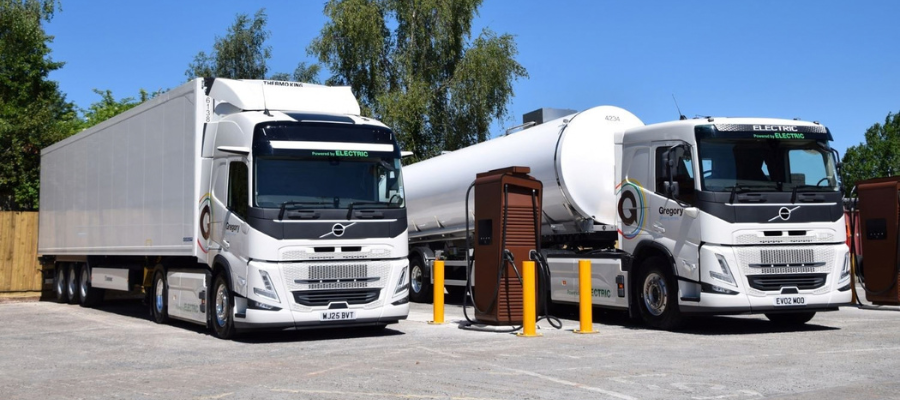
The whole initiative is self-funded by the industry partners, which gives licence to drill into the thorny subjects of electrification. Each fleet operator receives two 4×2 electric tractor units (equivalent to a gross payload of 42t) for three months on two occasions. They tend to start with simple shuttle runs, before finding the limits of their electric trucks with more ambitious journeys.
The attraction of Project JOLT
For the more visionary, there are five main reasons why fleet operators are joining Project JOLT:
- Strategic imperative to define a path to net zero – with pressure coming from customers and shareholders.
- Commercial – informing future purchasing strategies.
- Risk mitigation – the trial enables companies to build the plans and mitigate the risks needed for rolling out EVs through their fleets.
- Marketing – good publicity material.
- Financial – exploring the range of opportunities for reducing costs and proving the financially viable opportunities for electrification in each member’s fleet.
In addition to the round-robin trucks, there are trucks that have been bought by members. In total, there are 11 tractor units with data loggers on board. The data is gathered in and anonymised and pooled together. This data is then analysed and modelled.
Will my driver get back tonight?
Early scepticism of eHGVs starts with range. There are few available charge points if there are unexpected events. However, after some familiarisation, confidence grows and 250 miles have been achieved on a single charge when using motorways. Good driving can deliver a 15% improvement in range. David’s team is currently researching the effect of weather, traffic, topography, road types and charging regimes on the range.
What weights will it carry?
The rule of thumb is that a 44t 6×2 diesel tractor unit has the capacity to pull a net payload of 28-29t. This contrasts with a 42t 4×2 eHGV tractor unit which can carry a net payload of 22t.
This leads to some of David’s key work, which is to identify the cost of electrification. Weight constrained loads require the cost of running additional trucks, which makes them non-viable at present. In some instances, there is also a time penalty for charging, which will add extra cost.
Is it too expensive?
In these early days, charging points are limited. The cost of charging at third party stations is also costly when compared to using in-house facilities, with prices ranging from 17p/kWh to 80p/kWh. Heriot-Watt is collecting data from Project JOLT members and modelling the current operations. This will identify the impact of electrification and the optimum siting of charge points.
The cost of a new eHGV is around £300k, which compares to £120k for a new 6×2 tractor unit. Lower maintenance and fuelling costs mean that some operators can justify buying electric by proving a lower Total Cost of Ownership (TCO). This usually involves retaining the vehicle for seven years or more.
This is still an emerging market and Heriot-Watt is researching the steps required to establish a secondary market with viable residual values. New government grants will reduce the net cost of buying eHGVs in the short term.
Decarbonisation is an energy issue too
Energy infrastructure is crucial to electrification. It is needed to provide confidence that drivers will be able to reach their destinations and to facilitate “tramping” operations. Electrification is therefore as much an energy issue as it is a logistics one.
Project JOLT is quantifying the issues and finding solutions
These are early days in the path to net zero. Project JOLT is quantifying the issues before developing the solutions. Looking forwards, we can expect the cost of trucks to come down, battery performance to increase to realise greater range or payload, government incentives, improved infrastructure and optimisation of operations. Running an electric fleet will not necessarily have the same dynamics as those of a diesel one.
More Green Miles - Industry Insight Articles





Related Pages
Check out more news and media
Discover More

Become a Member
Our membership packages provide you with the tools to keep your operation safe, efficient and compliant.
Learn more

Press Releases
Latest updates, insights, and expert commentary shaping the future of logistics, transport, and supply chains across the UK.
Learn more

Services
Discover the full range of services from Logistics UK, designed to keep your operation safe, efficient, and compliant.
Services

Events
Discover upcoming Logistics UK events designed to bring industry leaders, policymakers, and businesses together.
Events
Stay Ahead. Stay Compliant. Stay Connected.
Join thousands of logistics professionals using Logistics UK to navigate industry change with confidence.
Join Us