












Green Miles - Industry Insight
Party leaders take note: clean transport is an economic priority
By Michael Shaw – CEO of Aegis Energy.
As the UK’s major political parties gathered for their annual conferences earlier this month, discussions around economic growth, investment and competitiveness dominated. The performance of a nation’s economy will always form a significant part of any election cycle, but recent concerns around stagnating growth and rising costs of living have made the issue even more pertinent than usual.
Too often, economic progress is framed as being in direct opposition to decarbonisation efforts. In reality, the opposite is true. Development in green energy, transport, and infrastructure is already driving new jobs, investment and technological leadership across the country.
Far from being a drag on the economy, the clean transition sets up Britain’s critical industries for a sustainable, profitable, and market-leading future – promising competitive advantages and growth for those willing to make strategic moves.
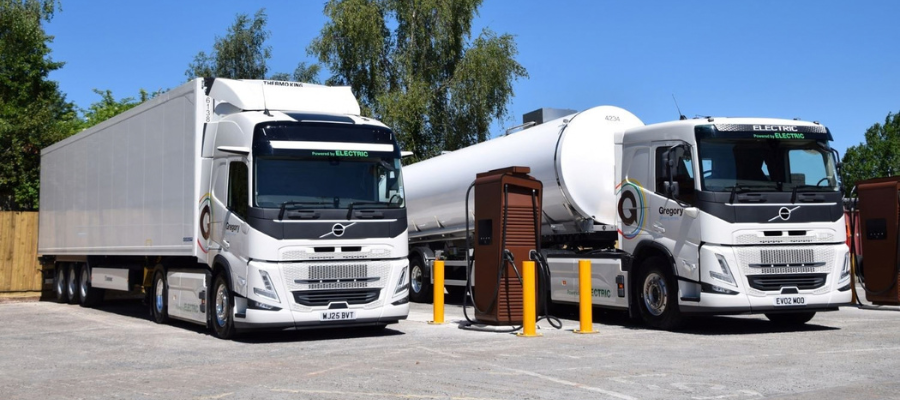
Nowhere is this clearer than in the commercial transport sector, where a national decarbonisation effort is beginning to take shape. The more fleet operators that can be supported to make the switch to cleaner vehicles, the more competitive and modernised the freight network will become, fit for the future of Britain’s economy.
A turning point for UK industry
The UK’s commercial transport sector stands at a pivotal moment – one that has direct implications for national competitiveness and economic growth. Fleet ambition, customer demand and government strategy are converging to make decarbonisation not just a policy target, but a tangible reality and engine for industrial renewal.
While understandable caution has held some operators back, the business case for electrification is becoming increasingly compelling. Upfront costs and infrastructure gaps are narrowing fast, and early adopters are already seeing measurable benefits in operational efficiency, customer engagement and brand reputation. What once felt experimental now looks inevitable and the businesses that move first will gain both market advantage and cost certainty in an evolving regulatory landscape.
Making the economics stack up
Cost remains a central consideration for fleet operators, but technology and supply-chain maturity are helping electric LCVs and electric HGVs approach price parity with their internal combustion equivalents. Recent research by the International Council on Clean Transportation forecasts that zero-emission trucks could achieve cost parity with diesel by 2030.
The long-term economics of electrification also tell a different story from initial purchase price alone. Further research found that electric vans can deliver between 19% and 25% lower total cost of ownership (TCO) than diesel equivalents over their lifecycle.
Similarly, research from Transport & Environment shows that battery-electric long-haul trucks could achieve TCO parity with diesel in Europe by 2026 — with UK operators already saving roughly €36 (£31) per 100km on energy costs.
In financial terms, this represents not a gamble but a strategic investment. As the Chancellor and business leaders have repeatedly argued, long-term productivity growth relies on innovation and capital deployment into modern, low-carbon industries. For logistics and haulage, fleet electrification is one of the clearest ways to achieve both.
Infrastructure investment as industrial strategy
Concerns over infrastructure are also being actively addressed by developers and investors. Aegis Energy is among the firms leading this charge, with plans to deliver 30 clean multi-energy hubs by 2030 and expand to more than 50 thereafter. These hubs are specifically designed for commercial vehicles, featuring bookable, high-speed charging, large-bay configurations, advanced security systems and driver-focused amenities.
Beyond convenience, such investment directly supports the UK’s economic priorities – boosting regional productivity, attracting private capital, and creating skilled jobs in construction, operations and technology. Developers like Aegis Energy are helping meet that demand while ensuring the UK remains competitive with Europe and the US in clean transport infrastructure.
For operators, early participation delivers a triple advantage: being able to secure access to prime refuelling locations, enjoying the next generation of driver-focused facilities, and influencing how the charging landscape develops. Initiatives such as Aegis’s Trailblazers programme – offering reduced charging rates and opportunities to shape the infrastructure that’s being developed – illustrate how proactive partnerships can shape a commercially viable and future-ready logistics network.
A strategic transition, not a risk
The firms transitioning today are positioning themselves ahead of the curve. As demand for charging access increases, those with established relationships with infrastructure providers will be front of the line. They will also benefit from a reputational edge that helps them win contracts and build trust. Businesses across retail, construction and manufacturing are already incorporating carbon performance into procurement processes, assessing logistics partners on their ability to cut Scope 3 emissions and demonstrate credible transition plans.
Aegis Energy customer Wordsworth Excavations, for instance, has reported strong client interest and new partnership opportunities following the introduction of electric HGVs into its fleet. This is clear evidence that decarbonisation now drives commercial advantage as much as environmental benefit. This shift is not merely reputational; it is structural, tied to procurement rules, corporate ESG standards and investor expectations.
A national opportunity for growth
Fleet operators face legitimate pressures of balancing tight margins with the need for building a fleet fit for the future and have valid concerns about upfront cost and infrastructure access. Yet these challenges are now being met by accelerated infrastructure deployment, favourable total-cost economics and growing customer incentives. The UK’s logistics industry – long a foundation of the national economy – has a rare opportunity to reinvent itself as a catalyst for sustainable growth.
Inaction now risks forfeiting competitive advantage to early movers. The balance of risk is changing: the greater threat lies not in transitioning, but in being left behind as markets, customers and policymakers align around cleaner, smarter transport. As we look ahead, the ongoing clean transport revolution should be seen as the driver of economic excellence that it is – and supported and celebrated as such.
More Green Miles - Industry Insight Articles





Related Pages
Check out more news and media
Discover More

Become a Member
Our membership packages provide you with the tools to keep your operation safe, efficient and compliant.
Learn more

Press Releases
Latest updates, insights, and expert commentary shaping the future of logistics, transport, and supply chains across the UK.
Learn more

Services
Discover the full range of services from Logistics UK, designed to keep your operation safe, efficient, and compliant.
Services

Events
Discover upcoming Logistics UK events designed to bring industry leaders, policymakers, and businesses together.
Events
Stay Ahead. Stay Compliant. Stay Connected.
Join thousands of logistics professionals using Logistics UK to navigate industry change with confidence.
Join Us