








Green Miles - Industry Insight
Life-Links: Strengthening the Transport Links that Keep Supply Chains Moving
By Sophie Punte, Co-Founder & CEO Life-Links and Board Member, Smart Freight Centre.
Supply chains are lifelines
When supply chains fail, everyone feels it, because supply chains are lifelines. Around 57% of global GDP depends on trade and its supply chains, supported by global logistics. Recent years have exposed the fragility of global logistics: extreme weather, geopolitical shocks, rising costs and infrastructure bottlenecks have disrupted flows of goods, finance and data. For example, 27% of global road and rail infrastructure is exposed to at least one natural hazard, and 86% of ports are exposed to more than three.
Shared risk, shared interest
To protect trade and livelihoods, resilience must become the next measure of performance. Resilience of logistics is not only a concern for logistics and transport companies that operate fleets, terminals and hubs, but also for producers and retailers whose competitiveness depends on the reliability of those systems.
SMEs are particularly exposed when disruptions hit, yet often lack the leverage to influence investment or policy decisions. When roads are washed out, rail lines are blocked or ports are congested, then companies lose revenue, countries lose trade, communities lose income, and consumers face shortages – everyone suffers. Strengthening those links is therefore in everyone’s interest.
Life-Links Framework
Life‑Links, an international NGO co-founded with the Kuehne Climate Center, bridges these interests to create “Resilient Supply Chains for Good” that benefit companies, communities, countries and consumers alike. The Life-Links Framework for Resilient Supply Chains and Logistics helps companies, governments, financiers and development partners translate supply chain risks into concrete measures that build resilience of critical transport and logistics links.
The approach involves selecting a supply chain and critical link(s), followed by three steps: risk assessment, selection of action measures, and coordinated implementation to create value for all partners. The framework builds on and lists existing guidelines and digital tools that companies already use to increase supply chain visibility, efficiency and decision making.
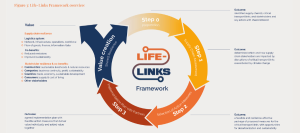
Step 0. Preparation: identifying critical links in supply chains
Selecting a critical transport or logistics link considers both the supply chain actors and dependent communities as well as vulnerability to climate change and other threats. For many companies, combining resilience with opportunities to reduce greenhouse gas (GHG) emissions from freight transport and logistics will also be an important factor.
For example, critical links for the £7 billion Scotch whisky industry could be roads that connect rural distilleries to bottling sites in Glasgow or Fife, or railways or ports to move containers within the UK and to 180 markets worldwide. A critical link could also be a first mile or corridor connecting Kenyan farms to the Port of Mombasa for shipment of flowers, vegetables and coffee sold in European supermarkets like Tesco or Lidl.
Step 1. Supply chain assessment: risks of disruption and impacts
A risk of disruption of the critical link is the result of the interaction between hazards, exposure and vulnerability. As a company, you want to consider climate-related hazards, such as storms, heavy rainfall, rising sea levels or extreme heat, but also trade tariffs, cyber attacks or strikes. Similarly, exposure is more than just a bridge, road or port on its own. Logistics infrastructure, operations and workforce, and flows of goods, finance and data are exposed, as well as any supporting systems like electricity and telecommunications networks.
A pragmatic approach is to define vulnerabilities as existing logistics challenges that make it difficult to move, store, and handle goods efficiently through a supply chain. Companies find this much easier to pinpoint, and risks become more tangible. Challenges can relate to infrastructure (eg poorquality roads or bridges), operations (eg warehouse bottlenecks), workforce (eg limited skills or heat stress), flows (eg broken cold chains or payment delays) and external (e.g. lengthy customs procedures or urban access restrictions).
This step assesses how these challenges lead to risks of delays and disruption, how stakeholders are impacted, and finally, how climate change is making this worse. For example, unpaved or narrow roads increase the risk of delays or disruptions from flooding.
Queues and customs delays at Channel ports can be lengthened by more frequent storms, and droughts will make it even harder for ships to get through the Panama Canal. This could lead to higher transport costs borne by transport operators, reductions in a country’s trade throughput and tax revenue, food waste and reduced income for farmers, and critical raw materials or fashion items arriving (too) late at car factories or retail outlets, affecting corporate profits.
The point is that today the logistics system might be coping with these challenges, but what will happen when the frequency and intensity of floods, heatwaves and other climate-related events increase as predicted? This could squeeze profit margins for farmers, producers or transporters to unsustainable levels, lead customers to cancel product orders due to higher prices, or make insurers decide that it is too risky to provide some ports with insurance for extreme weather events.
Companies know this is coming: 68% of BCI-surveyed companies see extreme weather events a threat to their supply chains in the next five years.
Step 2. Selection of action measures: resilience and co-benefits
In this step, potential action measures are identified, screened and analysed in detail to create a feasible, resilient and future-proof package.
Manufacturers and retailers will first try to avoid the risk, for example by repositioning assets from high-risk locations, near-sourcing, or reducing workforce deployment in hazard zones. Many accept that hazards will occur and rely on LSPs and transport operators to manage the risk by being better able to prepare, respond and recover from disruptions.
Examples of measures include spare critical equipment, higher inventory levels, dynamic routing, emergency scheduling and early warning systems. Life-Links prioritises measures that strengthen critical links: addressing underlying vulnerabilities within the logistics system itself for long-term, structural resilience across existing routes and its transport modes and logistics hubs.
Examples include upgrading existing infrastructure, multimodal integration within corridors, and flexible work hours to avoid, for example, the hottest part of the day, or days with strong winds. With accelerating climate change, such measures are indispensable.
Potential measures are assessed on financial and practical feasibility, whether they are genuinely effective in strengthening resilience, and deliver the strongest returns on investment. They should also be screened for unintended consequences, including ‘maladaptation’, and ensure that measures are fair, inclusive and sustainable.
After devastating floods in the German Ahr region in 2021, the government actively engaged residents, associations and local businesses on future land use, reconstruction priorities, and infrastructure needs to be better prepared for future extreme events.
Then it is time to actively look for complementary actions with decarbonisation and wider sustainability benefits. Research suggests that in freight transport systems around two-thirds of resilience-enhancing measures can also cut GHG emissions. For example, floodproofing warehouses can be combined with installing solar panels, or the redevelopment of port infrastructure could integrate nature-based solutions, such as mangrove restoration, to provide storm surge protection and carbon benefits.
Seek opportunities to strengthen the package and avoid duplication, building on what others already offer. Measures can be aligned with government policies, fiscal incentives or programmes, for example those relevant for transport in Europe. Investors and insurers are also shaping this agenda.
For example, HSBC’s Supplier Finance already includes adaptation financing, while Brunel Pension Partnership works with food and beverage companies on physical climate risks and investing in regenerative farming, and TT Club’s transport and logistics insurance increasingly factors in risks from supply chain disruptions.
Industry associations often have their own initiatives, such as the Scotch Whisky Association’s sustainability strategy and adaptation guide together with Adaptation Scotland, or reports with adaptation solutions by Associated British Ports and Resilience4Ports. LSPs’ decarbonisation support for transport partners could also cover climate resilience and adaptation.
Step 3. Implementation plan with partners: coordinated action and investment
Partnerships working on project or initiative implementation often face serious challenges, especially in agreeing ‘who pays what’ and how to balance individual gain with collective benefits. By concentrating on the most vulnerable ‘critical links’ rather than the whole supply chain or logistics network, benefits are more tangible, making it easier for partners to justify investments.
What also matters is that stakeholders such as companies, governments, development agencies or insurers can contribute in various ways. Some measures merely require coordination, for example, a regional trade corridor platform inviting private firms to coordinate their logistics upgrades with donor-supported infrastructure works.
Other measures require some form of collective investment through co-funding, guarantees or risk sharing, including through PPPs. For example, a retailer provides a product offtake guarantee, enabling a producers’ cooperative to secure a bank loan for a new packhouse. The Zurich Climate Resilience Alliance has identified emerging models for private participation in resilient infrastructure.
An example of where coordinated action can lead to greater benefits than when stakeholders act in isolation is Tanzania. The World Bank analysed flood patterns in transport routes for agricultural, processed food and manufactured goods consumed by households, that are also used by international buyers purchasing goods from or passing through Tanzania.
Two segments of critical trunk roads of 181km combined are prone to disruption from flooding, with households and companies impacted by price increases, shortages, business continuity risks and workers’ jobs.
The government could improve infrastructure resilience by constructing a new 200km road along an alternative route, strengthening existing roads with wider culverts and better materials that make disruptions from floods 50% less likely, or improving maintenance and preparedness for road repairs that shorten disruptions from four to three weeks.
Companies could significantly reduce losses from prolonged disruptions through operational measures: holding inventories for 5.5 instead of 4.5 weeks, having two suppliers per type of input instead of one, and nearsourcing to suppliers at an average distance of 60km instead of 190km. The combination of government-led infrastructure measures with company-led operational measures leads to greater collective resilience for households, local companies and international buyers.
Value creation: shared resilience and stakeholder benefits
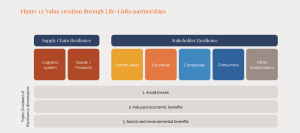
Value, in the form of ‘shared resilience’, is created at two levels: supply chain resilience of the logistics system and transported goods, and stakeholder resilience and co-benefits for communities, countries, companies, consumers and other stakeholders.
An example of how modernisation of transport systems to address logistics challenges can simultaneously drive resilience, decarbonisation and competitiveness is the East-West railway line from Azerbaijan to the Georgian border, which is a critical link in the Middle Corridor that connects Asia and Europe.
Three parallel measures were implemented by the government-owned Azerbaijan Railways, the global rail transport manufacturer Alstom, and the Asian Development Bank as the provider of a USD 47 million loan. These measures included an upgrade of the electric network and integration with the national grid, replacement of 100 locomotives from the Soviet era with 40 modern electric freight locomotives built for harsh climates, and partial renewable electricity generated from solar energy.
The combined measure delivers a ‘triple dividend of resilience’. The first dividend is avoided losses, through reduced failures of locomotives (availability increased from 70% to 90%), operations and the electricity network.
The second dividend is induced economic benefits in the form of reduced travel time (the speed doubled from about 20 to 40km/hr), lower maintenance costs, improved energy efficiency, higher transit and trade revenues for Azerbaijan, more reliable services for shippers, and increased freight volumes from under 800,000 tonnes in 2020 to 4.5 million tonnes in 2024.
The third dividend is social and environmental benefits, including better working conditions for drivers (new locomotives have temperature-controlled cabins), reduced emissions and cleaner air from efficient electrified railways with renewable power, and income resilience for workers and communities whose livelihoods depend on trade along the Middle Corridor.
Use the Life-Links Framework
The Life-Links Framework is meant to be applied. I invite companies, governments, and partners to use it in their supply chains, share learnings, and collaborate. Strengthening the transport links between producers and consumers builds shared resilience that benefits us all, creating the conditions for sustainable, inclusive trade.
More Green Miles - Industry Insight Articles


Related Pages
Check out more news and media
Discover More

Become a Member
Our membership packages provide you with the tools to keep your operation safe, efficient and compliant.
Learn more

Press Releases
Latest updates, insights, and expert commentary shaping the future of logistics, transport, and supply chains across the UK.
Learn more
Services
Discover the full range of services from Logistics UK, designed to keep your operation safe, efficient, and compliant.
Services
Events
Discover upcoming Logistics UK events designed to bring industry leaders, policymakers, and businesses together.
Events
Stay Ahead. Stay Compliant. Stay Connected.
Join thousands of logistics professionals using Logistics UK to navigate industry change with confidence.
Join Us