













Green Miles - Industry Insight
Government must accelerate regulatory reform for electric vehicle fleets
By Maddi Solloway-Price – Head of Road Freight & English Regions Policy, Logistics UK.
In a recent Fuel for Thought article, my Logistics UK colleague Stephanie Haszczyn examined former Roads and Local Transport Minister Guy Opperman’s assertion that logistics has reached its ‘tipping point’ on the journey to decarbonisation, suggesting that the hardest part is now behind us.
Stephanie rightly highlighted our sector as a leading example of progress, with operators investing heavily in cleaner technologies and innovative solutions. However, while the sector is driving change, the pace of progress is being somewhat held back by the pace of government regulatory reform.
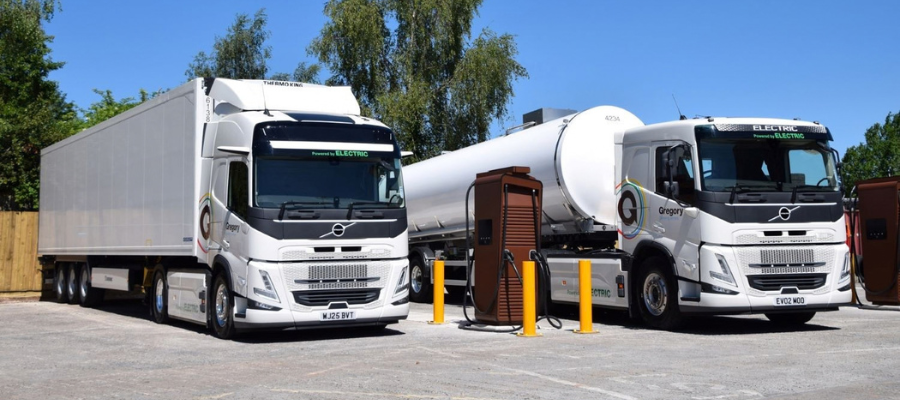
Our recent report, Powering Change: Building a Credible Plan for Decarbonising Road Logistics, highlights widespread uncertainty across the sector regarding government support, clear guidance, and infrastructure provision. This concern is echoed by our members, who consistently tell us of the challenge of transitioning to heavier electric fleets for both HGVs and vans without sacrificing payload, and the need for improved infrastructure to support decarbonisation.
The electrification of vehicles is essential to meeting decarbonisation targets, but for logistics businesses that often operate on extremely tight margins, any reduction in payload capacity represents a disincentive to invest in electric vehicles. This is particularly acute in our sector where vehicle utilisation and load efficiency are often critical to profitability.
Within current regulatory weight limits, operators are being asked to absorb the payload loss of electrification, which, in turn, imposes compromises on payload and undermines efficiency. If payload loss remains unaddressed, the risk is that electrification could be seen not as an opportunity, but as an operational burden.
The question is not whether decarbonisation should happen. Instead, the question is how we ensure it happens in a way that supports operators. That’s why a comprehensive review of vehicle weights and dimension regulations is urgently needed.
Operators need government leadership in this area, and they need it quickly. The challenges caused by 4.25 tonne electric vans being classified as HGVs due to battery weight illustrates this. This categorisation brought electric vans under rules such as drivers’ hours and training requirements, creating significant burdens for our sector.
Unfortunately, this situation also demonstrates just how long unfavourable regulatory changes can take to remedy. Following extensive engagement by Logistics UK, the Department for Transport has committed to introducing draft legislation aimed at removing key barriers to the adoption of electric vehicles up to 4.25 tonnes.
This builds on progress announced in May, when a Statutory Instrument repealed the five-hour training requirement and lifted the prohibition on towing for Category B licence holders in zero-emission vans up to 4.25 tonnes. However, as we enter 2026, operators are still grappling with regulatory inconsistencies between electric and non-electric vans.
This timeline underscores the urgent need for a more responsive, streamlined regulatory process, particularly as discussions around HGV weights and dimensions gather pace.
Logic suggests that larger, longer vehicles could carry more goods and, in turn, reduce the number of vehicles on the road, delivering both environmental and efficiency benefits. The challenge, however, is whether this principle holds true when our road infrastructure is aging and shaped by historical constraints and the complexities of modern planning.
Logistics relies on the motorway system but is not limited to it. Longer vehicles with additional axles would distribute weight more effectively, reducing the direct impact and stress on road surfaces. While of course these vehicles will be safe and meet key safety tests, they may struggle to navigate tight corners or roundabouts on narrow UK roads.
Many UK roads are currently unable to accommodate longer or heavier HGVs as they are too narrow and too winding and yet these roads remain integral to our logistics system. Larger, longer heavier vehicles that could, in theory, work on the M1 will not currently work on rural routes in the Peak District.
This creates a fundamental challenge for the government when addressing weights and dimensions of vehicles: is a ‘one size fits all’ approach to the weights and dimensions question viable?
The sector is ready for the next steps for electrification, but without a comprehensive approach from government, covering regulation, infrastructure, grid upgrades and implementation, progress will stall, and some businesses will struggle to innovate. Logistics UK will continue to work closely with government to emphasise the need for this joined up strategy and ensure that the voice of industry is heard at the highest level.
We may have reached the ‘tipping point’ for logistics decarbonisation, but to cross the finish line, regulation and infrastructure must keep pace with ambition.
If you would like to be part of the conversation on shaping solutions to this and future challenges for our industry, please consider joining our Future Road Regulation working group. To get involved, please email Maddi on [email protected].
More Green Miles - Industry Insight Articles





Related Pages
Check out more news and media
Discover More

Become a Member
Our membership packages provide you with the tools to keep your operation safe, efficient and compliant.
Learn more

Press Releases
Latest updates, insights, and expert commentary shaping the future of logistics, transport, and supply chains across the UK.
Learn more

Services
Discover the full range of services from Logistics UK, designed to keep your operation safe, efficient, and compliant.
Services

Events
Discover upcoming Logistics UK events designed to bring industry leaders, policymakers, and businesses together.
Events
Stay Ahead. Stay Compliant. Stay Connected.
Join thousands of logistics professionals using Logistics UK to navigate industry change with confidence.
Join Us