











Green Miles - Industry Insight
SMEs need to be aware of unique challenges ahead, says Logistics UK
In the UK, transport accounts for 30% of all greenhouse gas (GHG) emissions1, with 32% of those emissions attributable to heavy goods vehicles and vans.1 That means that this is an industry which must address its emissions for the UK to successfully meet its net zero by 2050 goal.
GHG emissions refer to the release of gases like carbon dioxide, methane, and nitrous oxide into the atmosphere. These gases trap heat, contributing to the greenhouse effect and causing global warming and climate change. It is human activities, particularly the burning of fossil fuels, which are the primary driver of increased GHG emissions. Global temperatures have accelerated in the past 30 years and are now the highest since records began.
The business challenge
One of the biggest challenges facing policymakers and investors is the lack of tangible data beyond the high-level emissions data which the Department for Transport publishes annually. It is impossible to reduce emissions quickly and efficiently when the information which breaks down the data in a granular way is not available.
To add to the challenge, over 99% of businesses in the UK are classed as Small or Medium Sized Enterprises (SMEs) and make up around 50% of the total emissions from UK businesses. However, according to NatWest Group, 87% of UK SMEs are unaware of their business’s total carbon emissions.4 This is not surprising as smaller businesses are not required to, or rarely have the resources or time to report on – and address – these emissions.
For large businesses, there has been a requirement to report on their scope 1 and scope 2 emissions since 2019 under the Streamlined Energy and Carbon Reporting (SECR) in company annual reports. Listed companies have always been subject to more reporting requirements, but large private companies also fall into scope of the SECR given the growing importance for the UK government to understand and address emissions from businesses across all sectors.
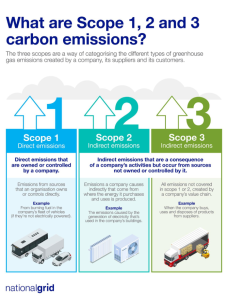
What are “scope” emissions?
Scope 1 – direct emissions, for example from your company vehicles.
- For logistics companies, scope 1 emissions will be much higher than for other businesses, for example one which is office based, or even a shop, as scope 1 for different businesses looks very different depending on what you do.
Scope 2 – indirect energy emissions that a company causes indirectly and come from the energy it purchases and uses.
- These emissions are indirect, as a business does not have control over these emissions, and subsequently, the UK government has been addressing this through its Clean Power 2030 mission. These emissions occur where the energy is generated (eg power station), and not at your company itself. scope 2 emissions will reduce as the source of electricity shifts to renewable generation.
Scope 3 – These emissions are not produced by the company itself and are not the result of activities from assets owned or controlled by it, but by those that it’s indirectly responsible for up and down its value chain. For example, if a business outsources its transport and distribution to an external company, these would fall into the business’s scope 3 emissions.

- Many logistics companies’ scope 1 emissions will be other companies’ scope 3 emissions. This is because a company’s “supplier emissions” would include the services like transportation and distribution which are outsourced to logistics operators.
The emissions reporting question
As emissions reductions climb the ladder towards more political urgency, there is a growing need for mandatory scope 3 emissions reporting. Reporting on scope 3 emissions is currently voluntary under the SECR.
The UK government is currently consulting on the final amendments to a new reporting requirement – the UK Sustainability Reporting Standard (UK SRS) – which builds on the work of the International Sustainability Standards Board’s (ISSB) work to create a global sustainability reporting standard. The idea behind this global standard is to create comparable data which investors can use to understand the climate risk associated with their investment, meaning the cost of capital can be amended accordingly. The UK government believes this will stimulate economic growth.
The UK is not alone in its pursuit of the UK SRS, with more than 30 jurisdictions globally also working towards introducing the ISSB standard into their legal and regulatory frameworks. The ISSB standard and the UK SRS are heavily endorsed by global and UK investors who want the comparable, high-quality information on emissions data, and climate risk, from UK companies and their suppliers.
Importantly for SMEs, the UK government has also committed to reviewing the need for the UK SRS to be written into legislation, including within the Financial Conduct Authority’s (FCA) Listing Rules as well as potentially introducing the requirements via the Companies Act 2006.
Should the government take this step and enforce the reporting of scope 3 emissions, there would be huge implications for logistics firms. SMEs would be compelled to report on their emissions data to fulfil the reporting needs of the larger companies they supply. Essentially, under UK SRS, if a large company is required to collect data on their scope 3 emissions, this company would need the emissions data from all its logistics suppliers. This would mean SMEs reporting – many for the first time – on their scope 1 emissions pertaining to the goods and services that are transported on the behalf of a larger company, as operations would fall into their reporting requirements.
Be prepared to report on your emissions
With the government’s focus on economic growth, it is likely that mandatory scope 3 emissions reporting is coming for large public and private businesses. The impact on SMEs will be significant, and the sooner companies prepare for this change, the better.
More Green Miles - Industry Insight Articles




Related Pages
Check out more news and media
Discover More

Become a Member
Our membership packages provide you with the tools to keep your operation safe, efficient and compliant.
Learn more

Press Releases
Latest updates, insights, and expert commentary shaping the future of logistics, transport, and supply chains across the UK.
Learn more

Services
Discover the full range of services from Logistics UK, designed to keep your operation safe, efficient, and compliant.
Services

Events
Discover upcoming Logistics UK events designed to bring industry leaders, policymakers, and businesses together.
Events
Stay Ahead. Stay Compliant. Stay Connected.
Join thousands of logistics professionals using Logistics UK to navigate industry change with confidence.
Join Us