












Green Miles - News Features
Seabound – delivering onboard carbon capture for the shipping industry
Freight shipping drives 90% of the world’s economy. Seabound locks CO₂ emissions in solid, easy-to-offload carbonate pebbles.
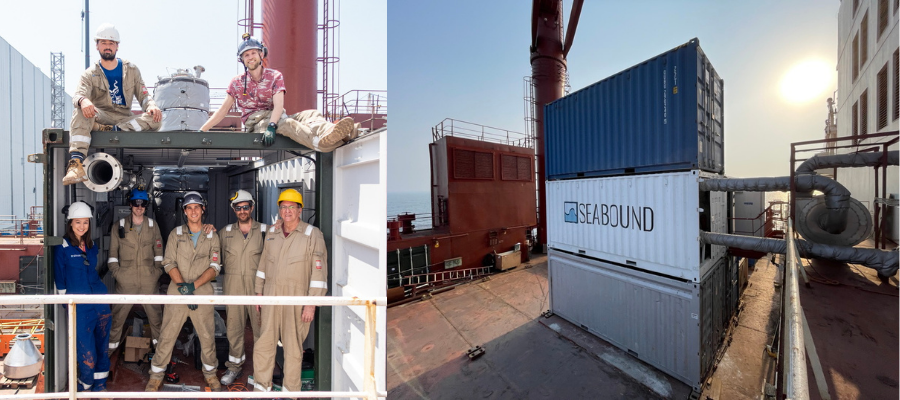
Start up company Seabound has developed a patent-pending compact carbon capture device that can be retrofitted into a ship’s engine exhaust at the funnel. The CO2 chemically reacts with pebbles of quicklime, which then convert into limestone, keeping the CO2 locked in.
The brains behind this venture is Alisha Fredriksson, a young entrepreneur and CEO of Seabound, who became interested in decarbonisation after reading a report from the Intergovernmental Panel on Climate Change that detailed the global implications of 1.5C (2.7F) v 2C (3.6F) of warming.
She and her co-founder, Roujia Wen, hit on the idea of scaling down the existing quicklime-based carbon-capture technology typically employed at industrial plants.

Carbon capture unit being loaded on to a tanker
“It became clear to me that everyone around the world will be affected by the climate crisis, and so if I cared about large-scale social impact, the best thing I could do would be to help tackle it. Then the question became ‘well, how?’”
The limestone pebbles are temporarily stored onboard before the ship returns to port, without any need for energy-intensive CO2 separation, compression, or liquefaction. Once back in port, the limestone pebbles are offloaded and either sold in pure form or turned back into quicklime and CO2, for the quicklime to be reused onboard another vessel and the CO2 sold for utilisation or sequestration.

OCCS is an advanced technology to capture CO2 from greenhouse gas emissions generated during vessel operation, ensuring it is not emitted into the atmosphere. This solution has the potential to play a significant role in reducing CO2 emissions in the medium term, especially for the existing fleet.
Successive prototypes of the Seabound container have taken her from the company’s test-bed in east London, to Turkish shipyards, the deck of a 3,200-container ship, and down the Suez Canal on a three-week voyage to test its efficiency. This showed that a Seabound unit can capture 78% of all the carbon from the exhaust that is pumped through it, and 90% of the sulphur, a toxic air pollutant.

Thousands of cherry-sized quicklime pellets soak up 78% of the carbon and 90% of the sulphur in exhaust fumes pumped through them.
The latest prototype is being built to the dimensions of a standard 20ft (5.9 metre) shipping container, so that it can seamlessly slot in with cargoes on deck, Fredriksson says. The design allows the stacking of several containers like regular cargo, and enables the ship to incrementally increase carbon capture in line with its journey length and decarbonisation goals.
With this innovation, Seabound hopes to capture large amounts of carbon directly from the decks of cargo ships, and help clean up the shipping sector.
More than 50,000 cargo ships are at sea at any moment, producing 3% of global greenhouse gas emissions – more than aviation.
More Green Miles - News Features Articles





Related Pages
Check out more news and media
Discover More

Become a Member
Our membership packages provide you with the tools to keep your operation safe, efficient and compliant.
Learn more

Press Releases
Latest updates, insights, and expert commentary shaping the future of logistics, transport, and supply chains across the UK.
Learn more
Services
Discover the full range of services from Logistics UK, designed to keep your operation safe, efficient, and compliant.
Services
Events
Discover upcoming Logistics UK events designed to bring industry leaders, policymakers, and businesses together.
Events
Stay Ahead. Stay Compliant. Stay Connected.
Join thousands of logistics professionals using Logistics UK to navigate industry change with confidence.
Join Us