










Green Miles - Interviews
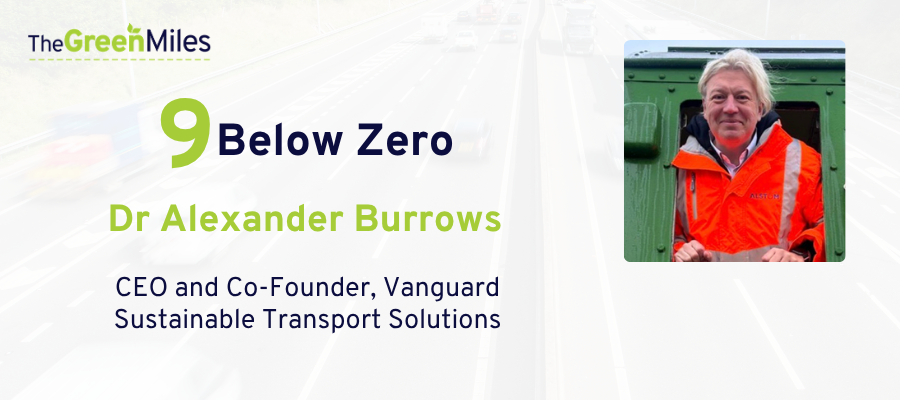
The Green Miles’ nine question decarbonisation challenge – Kasia Chodurek
With Aegis Energy’s Kasia Chodurek, Director of Business Development.
About Aegis Energy
Aegis Energy is building a national network of clean multi-energy hubs for commercial vehicles. The company partners with landowners and fleets to ensure sites are secure, conveniently located and equipped with a range of low and zero-emission fuels for logistics operations.
Kasia Chodurek has almost a decade of experience solving complex problems with B2B customers across investment and infrastructure. Prior to Aegis, Kasia spent six years at BlackRock in the Institutional Client Business, including two years as Business Sustainability Lead, and later served as Head of Distribution at FarmWorks, a high-growth agriculture scale-up in East Africa.
Let’s go… 9 Below Zero
9. What are the biggest common sustainability challenges facing the whole logistics sector in your opinion?
Infrastructure remains one of the biggest barriers to industry-wide decarbonisation. The UK still lacks a national network, designed specifically for the needs of commercial vehicles, that supplies clean energy alternatives to fossil fuels. The alternative – installing charging, bio-CNG, hydrogen and HVO on a depot system – is inaccessible for many fleets, especially those of small and medium sizes, due to extensive upfront costs and operational complexity.
Public and semi-public infrastructure that is well-planned, grid-ready and future-proofed is essential. Operators need confidence that wherever their trucks and vans go, they can charge or refuel safely, quickly and affordably. Until that’s consistent, the rest of the transition will remain uneven.
8. Do you think the UK’s net zero goals are realistic?
Yes, if collaboration remains central to how we work. The technology exists, the private capital is keen and policy is progressing. What matters now is alignment between the energy and transport sectors.
If we move together as policymakers, investors, operators and infrastructure providers, 2050 is achievable. The risk lies not in ambition, but in fragmentation.
7. What are the specific challenges faced by the different modal sectors?
Every mode faces distinct challenges. For vans, the main issue is a lack of reliable, fit-for-purpose charging. High-pressure, time-sensitive schedules with minimal downtime capacity mean that vans often require flexible, fast-charging options close to their operational hubs.
For HGVs, the scale of these challenges is even more acute. With longer routes and heavier loads, HGVs require high-capacity charging in strategic locations to support their operations. Since time windows and profit margins are usually low, reliable, dedicated truck charging facilities are essential to making the transition viable for HGV fleets.
Building infrastructure that meets these needs is a challenge, but it’s clear that without fast, accessible and affordable charging for operators, the rest of the transition slows. We need to remove that uncertainty so fleets can plan their operations with confidence.
6. What are the best examples of positive breakthroughs you have seen in the last decade?
The most significant milestone is the growing proximity to total cost of ownership (TCO) parity between electric and diesel trucks and vans. Electric vans are now achieving TCO parity with their diesel counterparts in almost all use cases, whilst trucks on the lighter end are close to achieving this cost-comparison. For the heaviest of HGVs, the gap is yet to be closed, but with falling battery prices and improved energy efficiency, it’s certainly on the horizon.
As the economics improve, the environmental and commercial cases for change finally align. Once TCO parity is reached, the transition accelerates naturally – operators will choose zero-emission options not just because they should, but because it makes business sense.
5. Who is an inspirational figure in decarbonisation in logistics?
I think of Adriesue “Bitsy” Gomez, a truck driver who broke barriers in the 1970s. She began by working in the Los Angeles produce market, loading and unloading trucks, and then became a relief driver, navigating an incredibly male-dominated industry.
Realising how unwelcoming trucking was for women, she founded the Coalition of Women Truck Drivers, a 150-member organisation that challenged sexism in the industry – starting with campaigns for female restrooms at truck stops and then moving on to broader issues of discrimination.
That defiant spirit is what this transition needs. The decarbonisation of freight will be driven by people willing to lead, to invest, experiment and collaborate before it’s easy or expected. Diversity of thought, background, and perspective has always been a spark for meaningful change, and we’re seeing that again now.
4. With the growing emphasis on sustainability, do you see rail freight competing with road and air transport?
Every operator should choose the mode that enables them to decarbonise the fastest and cheapest – and if that’s rail freight, great. However, I don’t think we will see road freight replaced. It remains essential, connecting the entire logistics chain from ports to warehouses to retailers. That’s why it’s so important that road transport decarbonises quickly, efficiently, and profitably.
I also think there is value in looking beyond rail and road transport, too. From drones and last-mile bikes to river boats, there is an expanding toolkit of transport modes that operators should make the most of in their mission to lower emissions while still meeting high customer expectations.
The goal isn’t to replace road freight, but to make it cleaner and more resilient. When we get that right, it strengthens the whole economy.
3. How do logistics companies deal with ‘first mover hesitancy’?
Hesitation is understandable; change at this scale carries risk. But the reality is that every fleet will have to make the transition sooner or later, and those that act now will be in the strongest position.
The advantages for early movers are real: discounted charging rates, priority access to infrastructure, and stronger influence over how and where the infrastructure is developed. For example, through the Aegis Trailblazers initiative, we’re supporting fleets that are ready to move early, offering discounts and opportunities to shape our network as it develops.
Transitioning first takes courage, but it also unlocks competitive advantage. Those who shape the system from the beginning will reap the long-term rewards.
2. What does 2025 look like for logistics decarbonisation?
This year feels like a turning point. For the first time, the conversation has moved beyond whether fleets will decarbonise to how quickly and profitably they can scale their plans. The industry has spent years building understanding, running pilots and testing new technologies – now the focus is on scaling what works.
I see 2025 as a year of alignment. Looking forward, fleet operators, energy experts and investors need to continue to align to ensure infrastructure is ready when large-scale demand hits. For electric vans, given that the economics are now favourable, I believe we are at that tipping point.
The transition to zero-emission freight depends on that foundation being in place. Do we have ‘Terra Firma’? Once it is, everything else becomes simpler.
1. You are Prime Minister for one day – what one thing do you do/change?
If I were Prime Minister for a day, I’d find ways to make projects like ours easier to scale. We have a talented and motivated group of people at Aegis Energy who desperately want to build the infrastructure that our commercial fleet customers need. We have the capital to do it. We need to streamline the planning and grid connection processes so that charging and clean refuelling networks can be delivered quickly and reliably.
More Green Miles - Interviews Articles


Related Pages
Check out more news and media
Discover More

Become a Member
Our membership packages provide you with the tools to keep your operation safe, efficient and compliant.
Learn more

Press Releases
Latest updates, insights, and expert commentary shaping the future of logistics, transport, and supply chains across the UK.
Learn more
Services
Discover the full range of services from Logistics UK, designed to keep your operation safe, efficient, and compliant.
Services
Events
Discover upcoming Logistics UK events designed to bring industry leaders, policymakers, and businesses together.
Events
Stay Ahead. Stay Compliant. Stay Connected.
Join thousands of logistics professionals using Logistics UK to navigate industry change with confidence.
Join Us