












Green Miles - Interviews
The Green Miles’ nine question decarbonisation challenge – Guy Opperman
Guy Opperman was the Minister for Transport and Logistics in Rishi Sunak’s government from 2023-2024. Prior to that he was the Minister of State for Employment with responsibility for growing the logistics sector.
As Transport and Logistics Minister, Opperman supported the Generation Logistics campaign, hosted the sector in a parliamentary reception in February 2024, and made multiple visits to transport hubs and businesses from Fergusons in Cramlington to Elddis in County Durham, and multiple other sites across the country.
Since 2024 and leaving politics, Opperman has established himself as a consultant and advisor to a variety of countries and corporates. As a minister, he passed Environmental, Social, and Governance (ESG) legislation in the UK, as well as legislation committing the UK to net zero by 2050.
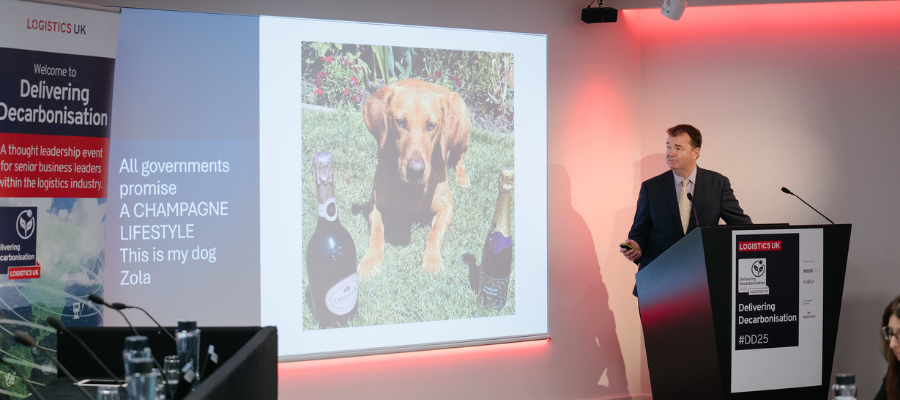
Opperman delivered the keynote at Logistics UK’s Delivering Decarbonisation 2025 conference in the City of London on 27 November 2025 which is where TGM Editor Tim Southwell caught up with him.
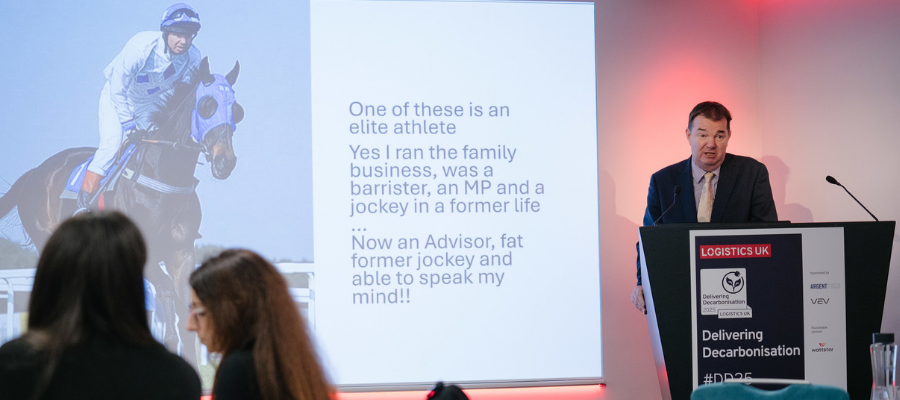
Opperman speaking at Logistics UK’s 2025 Delivering Decarbonisation Conference.
9. In your view, what are the biggest and most common sustainability challenges facing the whole logistics sector?
I would say there are three: energy creation, political consistency, and by far the most important is the collision between profit and climate. When the two collide, what decision is made?
I thought it was really interesting listening to Stuart [McCallion] from Segro (at Logistics UK’s Delivering Decarbonisation 2025 conference), who was really eloquent, and is clearly doing great stuff. But he made one comment, which I’m afraid is the harsh reality which is that projects need to be profitable.
All of the direction of travel on net zero, on decarbonisation, is wonderful when the project is saving the individual business long-term financially and you can get it past your CFO [Chief Financial Officer] and your Chief Executive and your board.
The tricky bit comes when (which we’re approaching very soon) you’re no longer engaged in decarbonisation projects that are necessarily profitable to your business or saving you money but are going to cost you money. That’s where the real rubber hits the road.
That is the biggest challenge and that is where it is quite clear, as [a conference panellist] said, net zero by 2100, that seems very, very logical and sensible. Net zero by 2050 seems much harder unless you are willing to invest for the change and accept a lack of profit, and very few companies are.
It’s the juxtaposition between short term, medium term and long term, isn’t it? If there’s a belief in the long term, if you can afford it to get there, then you’ll be prepared to invest in the short term and take a hit. The bigger companies can probably sustain that but it’s much more challenging for SMEs.
Let me give you the three big companies who jump out at me. In America, FedEx, in the UK, Amazon, and Nissan, are all massive companies. I looked it up because there was a lovely man talking at the conference from Amazon who was very, very eloquent and very good.
But do you know how much their revenue was last year? US $574 billion. Their declared income, in other words net income after all their expenditure, was US $30 billion. So, they’ve got the deep pockets to go and do all the lovely stuff he’s talking about.
Small little businesses up and down the country, or even big ports, just cannot afford that.
8. Do you think the UK’s net zero goals are realistic?
By 2050 for this sector, I think it is highly unlikely, unless there is either positive legislation coercion by government, or greater subsidy or specific action by sector leaders that is copied by others. I think it is accelerating, and things are happening really fast.
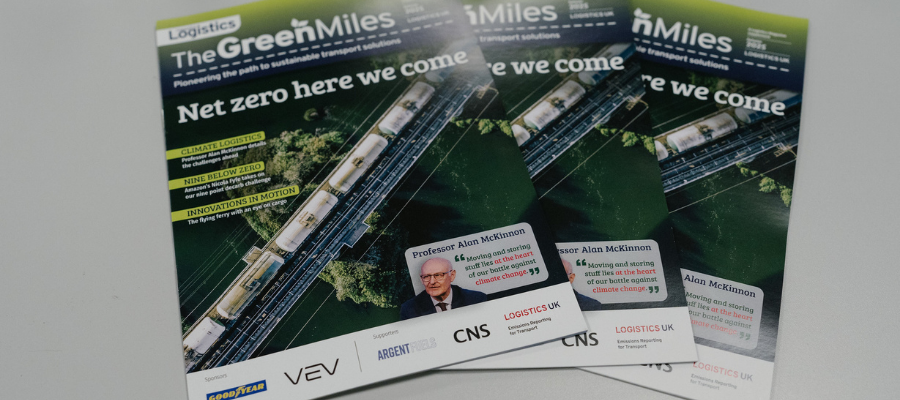
But don’t take my word for it. I read your report in a previous issue of The Green Miles and the last paragraph of Professor McKinnon’s paper says, in recognition of the magnitude of this task, perhaps climate logistics activities could be given longer to reach net zero targets and/or awarded special carbon credits for the key roles they’re playing.
In other words, he doesn’t think we’re going to get there. Where decarbonisation meets profit and the two align, there is a huge amount of effort being undertaken. No question, whatsoever. The problem is you’ve got to do the really tricky bits and they do cost money.
The second bit, energy creation, is really difficult and we are short of energy in this country.
7. Do you think it’s wise for the government to be fixated with electric and not look properly at hydrogen and other zero- and low-carbon fuels?
So, it is tricky with hydrogen, and I’ve been to the UAE and I’ve sat down with Middle Eastern organisations I’ve been to the Siemens plant right by the sea, right by the biggest solar farm in pretty much the entire planet, which is in the United Arab Emirates. It’s so big, you can’t see the end of it, it just goes on as far as the eye can see.
Hydrogen, in certain circumstances, works beautifully. But it’s really tough to store and it is really heavy. We have not found a way to re-engineer all the gas and oil pipelines up and down the country.
I went to the Shetland Islands, where there’s a massive depot for North Sea oil and gas to come in. The idea was to convert these giant hubs into hydrogen hubs. They were looking at it, but the logistics of it and the capability of it and the pressure of hydrogen is different from oil and gas, and so is very, very difficult. It requires unbelievably large amounts of expenditure, and you need to be able to create the hydrogen, and then you need to adapt all the vehicles.
I’ve also been to Musselburgh, where there’s a hydrogen village. Essentially, there’ are 200 houses all built on hydrogen, but it’s expensive and it’s difficult.
There’s a degree to which certain sectors of the energy industry would be very anti-hydrogen, because that would – how can I put it delicately – impact upon their business. So, they would ramp up the dangers of hydrogen and the likelihood of hydrogen explosions and things like that. So don’t imagine that the path to motherhood and apple pie is easily woven.
At the moment, the easiest thing to do is to have mass-produced power creating electricity. That’s the easiest and cheapest way. Hydrogen would be wonderful if it was commercially available, easy to store, easy to create, and those things don’t apply at the moment.
6. Who is an inspirational figure in logistics?
Alan Ferguson, great man, a really traditional Northumberland man, who is converting his fleet and is a fantastic local employer and has become a good friend of mine.
5. Do you see rail freight competing with road and air transport?
No, I don’t. I think there is a greater role for rail, but I think if the progress that we’re seeing on EVs in road continues, then I think that everybody will just continue to use road.
The tipping point for me is when you take a traditional business, like road freight, which is very fossil fuel heavy, and a bunch of lovely businessmen like the Alan Fergusons and all the other small-to medium-sized logistics businesses, and you say to them, ‘OK, you’ve got about 10 years to convert every single one of your vehicles to EVs.’
Well, they are actually going ahead and making that commitment at a great cost. So, by the time we get to 2030, infrastructure has to catch up.
We don’t have many electric railways, it’s really expensive to put in. So, I think that road freight is not going away.
4. How do logistics companies deal with first mover hesitancy?
I think you laud and applaud the ones who have dived in first, who tend to have the deepest pockets. FedEx, Amazon, Nissan, right? Then look at road freight, which is a great example. The ones who’ve then gone, ‘All right, it’s going to cost us, but this is the direction of travel. And also we can make it cost beneficial to ourselves, so we’re going to reduce our costs.’ I think you’ve just got to keep making the case for these people and support them.
As you rightly said, set out the direction of travel so it’s utterly clear. I think it gets more complicated when politics does get involved. For example, in America, the stuff that Trump is doing in the decarbonisation arena is off-the-charts different to what we are now doing. He’s actually cancelling it, genuinely. So ESG is a swear word there, it is. There are no wind farms. There is no funding for any decarbonisation.
People in this conference are saying, ‘Government could give us more carrots.’ Look what’s going on over there, and then I think you’d be a bit more grateful to the carrots that are coming your way.
3. What does 2026 look like for logistics decarbonisation?
I think more of the same, more progress on EVs, more progress on the easier targets. My concern would be – I haven’t gone through the Budget in detail – but it’s pretty clear that there is relatively little money coming to the logistics sector by way of carrots in any way, shape or form. In fact, it may even get smaller.
And I know from bitter experience of the transport budget that you have to really delve down and go, ‘OK, what’s the funding to the various smaller parts of the Budget?’
I was [minister of] roads, buses, logistics and a few other things – cycling, devolution as well. I knew how much my budget was to try and turn all the country’s buses into electric or hydrogen vehicles. I knew how much my roads budget was. However, that got cut by successive governments, as the pressure got impacted. Then I had a similar budget to spend on logistics which went towards pump-priming – financial awards for various innovations in decarbonising the sector.
The bit I will be curious to know is where are we compared to ‘22, ‘23, ‘24, ‘25, ‘26 in terms of those funding streams? You can’t tell until you’ve really gone through the red book, and then you’ve done the finance settlement, the spending review.
2. What are the best examples of positive breakthroughs you’ve seen in the last decade?
Look at individual bits of sectors. I was the buses minister and now pretty much every bus is an EV or hydrogen bus. We took a really traditional fossil-fuel business and we transformed it by throwing a chunk of money at it. You go anywhere in the country and there are electric buses, and if they’re really clever they’re using hydrogen buses.
And cheap to use too…
Of course they are. You’re then in a situation where you say, well, that was the easy stuff, because a bus, very simply, has a depot, fires itself up, goes off, does its work, comes back, refuels.
That’s the easy bit. The next easy bit, to a certain extent, is freight, because road freight, as you get greater charging capacity, will move into a situation where you will see ever greater numbers.
1. Imagine you’re Prime Minister for a day and you have a magic wand. You can do one good thing, or change one policy. What would it be?
Easy answer. I would bet the entire farm on nuclear and build so many nuclear power stations. This country will not solve its myriad problems until we get plentiful energy. We won’t get to net zero without nuclear.
We presently have the highest energy costs in Europe. One of the reasons we’re so uncompetitive, why our productivity is down, is we just need to spend more money on nuclear and the government needs to really get behind it.
More Green Miles - Interviews Articles


Related Pages
Check out more news and media
Discover More

Become a Member
Our membership packages provide you with the tools to keep your operation safe, efficient and compliant.
Learn more

Press Releases
Latest updates, insights, and expert commentary shaping the future of logistics, transport, and supply chains across the UK.
Learn more
Services
Discover the full range of services from Logistics UK, designed to keep your operation safe, efficient, and compliant.
Services
Events
Discover upcoming Logistics UK events designed to bring industry leaders, policymakers, and businesses together.
Events
Stay Ahead. Stay Compliant. Stay Connected.
Join thousands of logistics professionals using Logistics UK to navigate industry change with confidence.
Join Us