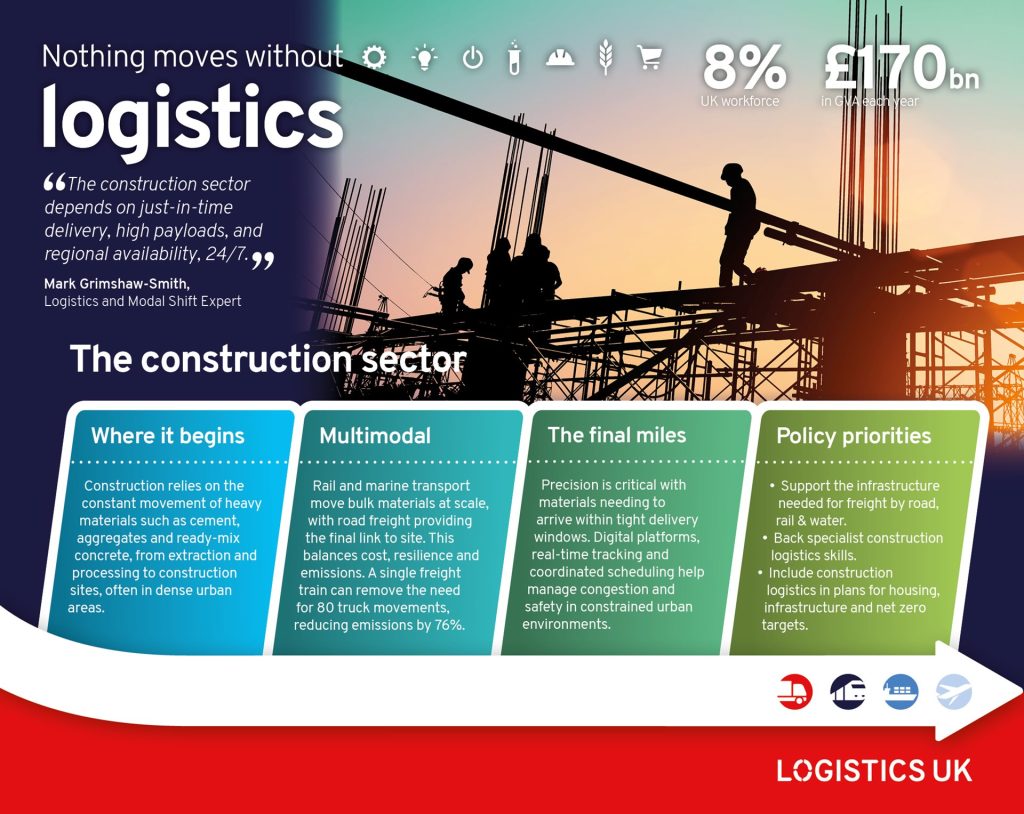










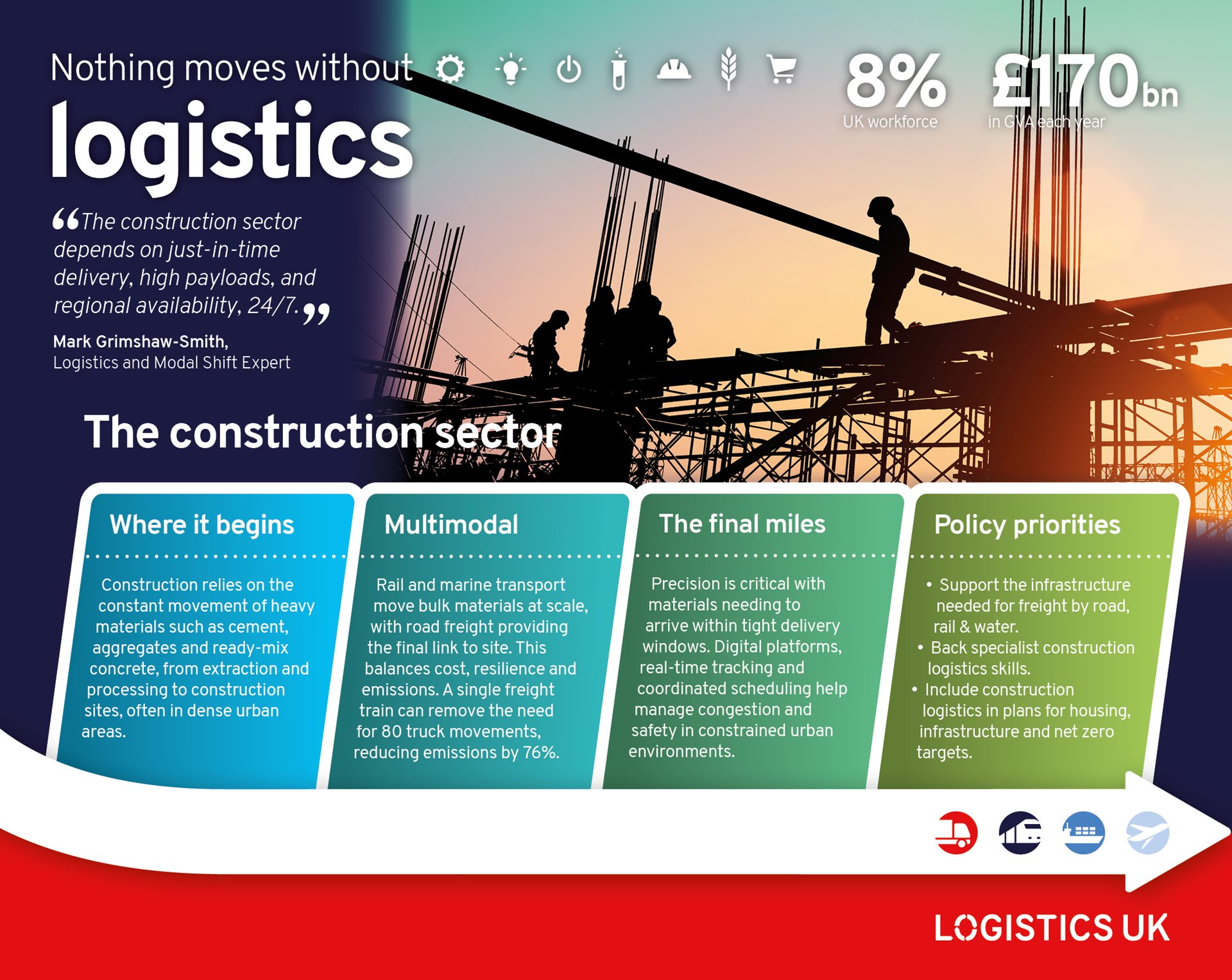
Nothing moves without logistics
Nothing moves without logistics, including the construction sector
Nothing moves without logistics – and nowhere is that truer than in construction. The materials that build the UK’s homes, hospitals, schools, transport networks and energy infrastructure are heavy, time-critical and needed at scale. Their movement underpins housing delivery, clean energy deployment, economic growth and resilience. Without reliable logistics, construction stalls.
Construction logistics is fundamentally about moving vast volumes of essential materials – cement, aggregates, ready-mix concrete and asphalt – from extraction, through processing, to construction sites, often in dense urban and inner-city areas. These flows must operate continuously, predictably and safely, often 24 hours a day, to keep projects on track and costs under control.
As logistics and modal shift expert Mark Grimshaw-Smith explains, construction depends on networks designed specifically for scale and reliability: “The construction sector depends on just-in-time delivery, high payloads, and regional availability, 24/7.”
Multimodal journeys from source to site
Construction materials rarely travel by a single mode of transport. Their journey typically involves a carefully sequenced combination of rail, marine and road freight, designed to balance cost, capacity, emissions and reliability.
Aggregates extracted from quarries are often loaded directly onto rail, moving millions of tonnes each year across the UK to rail-connected depots. Many of these depots sit alongside ready-mix concrete or asphalt plants, enabling materials to be processed close to demand before making the final journey by road to construction sites.
Marine transport plays a similarly critical role. Sand and gravel dredged from the seabed is delivered by ship to river and estuary wharves, where it can move onward by barge or road to construction sites. Cement clinker imported by sea is processed domestically and distributed across the UK, supporting large-scale construction activity.
This multimodal approach is not incidental. It is fundamental to keeping materials flowing at the volumes required for national infrastructure and housing programmes, while managing congestion and emissions.
Rail and modal shift at the heart of construction logistics
Rail freight is a central enabler of construction at scale. By transporting large volumes of material in a single movement, rail reduces pressure on the road network while providing the reliability that major projects demand.
Recent investment in new rail-connected depots illustrates this impact. A newly opened rail depot in the East of England, developed through close collaboration between logistics operators, customers, rail freight companies and the rail network, is now removing approximately 80 trucks from the road for every train delivered. This equates to a 76% reduction in CO₂ emissions for those movements, while improving supply certainty for customers.
For construction, rail is not just a lower-carbon option. It is often the only viable way to supply dense urban and inner-city areas at the scale required. Guaranteed freight paths, sufficient rail terminal capacity and protection of existing sites are therefore essential to keeping construction programmes moving.
The final miles: precision under pressure
While rail and marine transport move bulk materials into regional markets, construction logistics ultimately succeeds or fails in the final miles.
Construction sites operate to tight schedules. Concrete, aggregates and asphalt must arrive within precise delivery windows, often to constrained urban locations, and delays can bring entire sites to a halt. This places intense pressure on logistics planning, vehicle availability and traffic management.
Delivering into cities also requires careful coordination with local communities and authorities. Managing vehicle movements safely, minimising congestion and maintaining access are all part of operating responsibly at scale. Digital platforms and real-time tracking, along with coordinated delivery schedules, are increasingly essential tools for managing these pressures.
Operating responsibly: safety, skills and licence to operate
Construction logistics operates in close proximity to communities, schools and other road users, and maintaining the right to operate means putting safety first – for workers, for customers and for the public. This requires investment in driver training, modern vehicle fleets and safety technology, from enhanced driver visibility aids to anti-fatigue systems on road and rail. It also means engaging directly with communities, through rail safety education with schools, road safety campaigns and direct engagement on blind spots and safe behaviour around heavy vehicles.
The sector relies on a wide range of specialist skills: drivers and plant operators, logistics planners, compliance specialists, procurement teams and increasingly policy and regulatory experts. Recruiting and retaining these people remains a challenge, even as construction activity grows. Apprenticeship schemes, continuous training and a strong safety culture are critical to building a resilient workforce.
Investment and innovation
Construction logistics is evolving rapidly. Investment is flowing into:
- New and upgraded railheads to expand access to metro markets.
- Digital platforms providing real-time visibility of deliveries.
- Modern, safer and lower-emission vehicle fleets.
- Enhanced safety training for road and rail operations.
These investments improve efficiency, resilience and environmental performance, but they depend on supportive policy frameworks and long-term certainty.
Why policy matters
Construction logistics is highly sensitive to policy decisions. Limited rail capacity, uncertainty over future freight paths and congestion at ports and in urban areas can quickly translate into delays, higher costs and missed delivery targets.
Without logistics networks that can meet inner-city demand at scale and with lower emissions, the UK will struggle to deliver its housing ambitions, national infrastructure programmes and clean energy transition.
As Grimshaw-Smith notes, “Policymakers should better understand the importance of rail depots in the metro market areas and the rail paths to support this.
“Without lower carbon logistics networks that meet inner city demand, the UK will not deliver its housing infrastructure growth targets or clean energy ambitions.”
Conclusion
Construction enables almost every national goal the UK has set itself, from housing and infrastructure to clean energy and economic growth. But construction itself depends on logistics that can move vast quantities of material reliably, safely and sustainably.
Rail-enabled supply chains, resilient multimodal networks, skilled people and responsible operations are not peripheral to construction. They are its foundation.
In short: nothing moves without logistics, and without it, construction cannot deliver the UK’s future.
Policy priorities to enable construction logistics
- Protect and expand rail depots serving urban markets, with guaranteed freight paths to support large-scale construction demand.
- Enable modal shift from road to rail and water, recognising the congestion and carbon benefits this delivers.
- Support planning and protection of key logistics sites and corridors critical to construction supply chains.
- Recognise the specialist skills required in construction logistics and support training and workforce development.
- Ensure infrastructure and transport policy reflects the role of logistics in delivering housing, infrastructure and net zero targets.