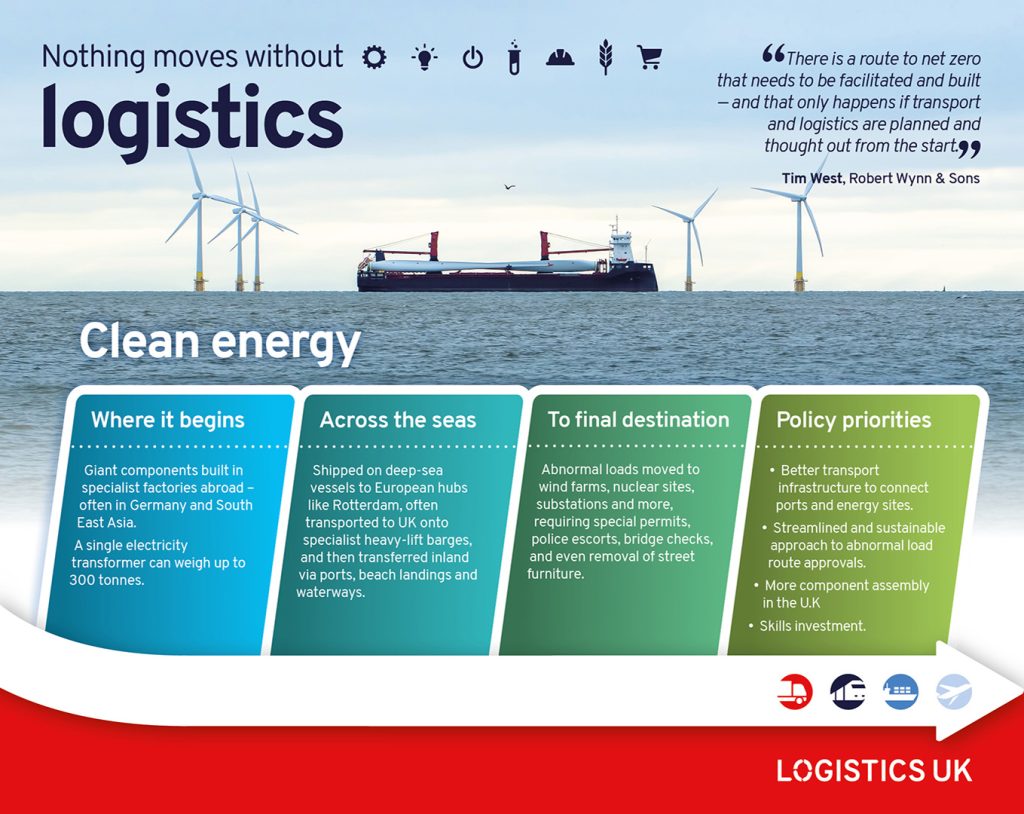










Nothing moves without logistics
Nothing moves without logistics, including clean energy
The UK’s net zero ambitions depend on a steady, reliable flow of heavy, complex components arriving at precisely the right time and place. In the clean energy sector, that means transporting giant transformers, generators, subsea cables, and large component parts for offshore wind, nuclear, battery storage, solar and interconnector projects.
These are often abnormal indivisible loads – items so large they cannot be dismantled for easier transport. A single transformer for an electricity interconnector or a solar / battery storage site can weigh up to 250–300 tonnes. Offshore wind turbines can exceed 500 tonnes in total weight, with each blade stretching 80–100 metres.
As Tim West, Director at Robert Wynn & Sons explains: “There is a route to net zero that needs to be facilitated and built — and that only happens if transport and logistics are planned and thought out from the start.”
From manufacturer to site
Most of these components are manufactured overseas. Transformers, for example, are often produced in Germany, Korea, or Southeast Asia and shipped to Europe on deep-sea vessels. From continental hubs such as Rotterdam, they are transferred to the UK using specialist heavy-lift vessels, such as the unique sea-going barge operated by Robert Wynn & Sons, one of only a handful of UK firms with the capability to deliver such loads by road or water.
The choice of UK port is dictated by more than geography. Specialist berths at locations like Teesport, Great Yarmouth, and Able Humber are designed for abnormal loads, while some power stations still use dedicated berths that were built decades ago. Increasingly, innovative approaches such as beach landings and the use of inland waterways are helping to shorten road journeys, cut congestion, and reduce environmental impact and economic disruption. With greater investment and planning, the UK could unlock far more capacity in these routes to accelerate the clean energy transition.
The critical final miles
Once ashore, components travel on dedicated vehicles, often under police escort. UK law requires special permission for moves over 150 tonnes gross weight, with authorities directing operators to minimise road mileage. This demands meticulous route planning to avoid weak and low bridges, or tight junctions and roundabouts, all while balancing cost, safety, and the impact on other road users.
Infrastructure constraints are a growing challenge. New clean energy sites are often in locations never designed for abnormal load traffic. Temporary bridging solutions and street furniture removal can add hundreds of thousands of pounds to delivery costs. Without coordinated planning between the Department for Transport, National Highways, and the Department for Energy Security and Net Zero, the risk of delay to key projects increases.
According to Tim West at Robert Wynn & Sons, “It’s becoming more and more challenging to move these big and heavy pieces of equipment because much of the infrastructure was never designed to accommodate them.”
Why this matters for net zero
The government’s clean power mission demands unprecedented year-on-year growth in renewable energy generation. Achieving this will require greater logistics efficiency across the supply chain, from faster permitting processes to better last-mile infrastructure and investment in multi-modal transport, including short sea shipping and inland waterways.
The resilience of this supply chain depends not just on ships and trailers, but on the highly skilled people who plan and execute these moves. From marine crews to abnormal load engineers, the expertise is rare, and the sector competes globally for talent. Sustaining and growing this skills base will be as important to net zero as building the turbines and substations themselves.
Tim West at Robert Wynn & Sons is clear that: “Only through collaboration between transport and energy departments within central government, local government and experts in the private sector will the net zero aspiration be achieved.”
In short, the clean energy sector cannot move forward without efficient logistics. From the port crane to the final bolt tightened on site, every stage of the UK’s green transition depends on moving these giant, high-value components safely, on time, and with minimal disruption – a logistics challenge on a truly national scale.
Policy priorities to enable the logistics sector to boost clean energy
- Better road, rail and waterway infrastructure to connect ports and energy sites
- Streamlined and sustainable approach to abnormal load route approvals
- More component assembly in the UK
- Skills investment